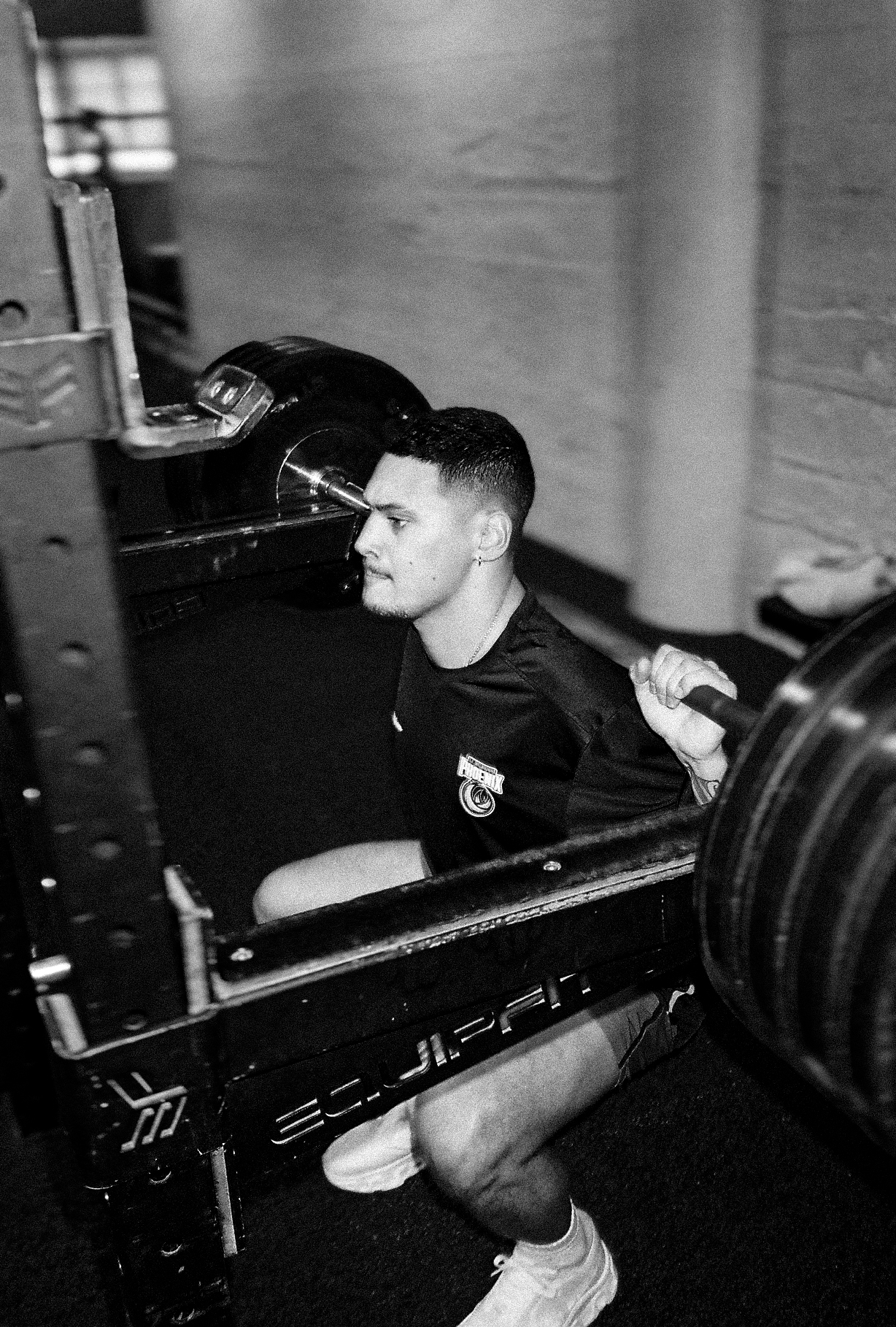
Isometrics are one of the simplest and most effective ways to understand and train the body’s capacity to produce, transmit, and resist force. They remove movement from the equation and reveal how well the body can produce or resist force in a fixed position. An isometric contraction occurs when the body produces force without any visible change in joint position. In practice, this can mean applying force against an immovable object or holding a position while forces act against you. These are two sides of the same coin. Isometrics can be applied across countless exercises and positions to create highly specific adaptations, which is why creativity is your friend when the aim is to load particular muscles, tendons, and joint angles. The contraction itself is simple, but what you do with it is where the method takes shape.
At ASPER, we treat isometrics as a way to train the moments when movement stops but force must still be produced or resisted. Those moments exist in almost every sport. They also exist in ordinary life whenever the body is exposed to demand.
WHEN THE BODY HAS NOWHERE TO HIDE
In dynamic movement, rhythm does a lot of quiet work. Timing and momentum can carry an athlete through positions they do not actually own. Take the movement away, and the truth boils to the surface surprisingly quickly. Put simply, the position can either be held or it cannot.
That honesty is useful. Isometrics allow a coach to place an athlete in a specific position and ask one of two questions: can they apply force against something that refuses to move, or can they hold their shape while force is applied against them? These are often described as overcoming and yielding isometrics: the heads and tails of the coin referred to earlier. Pushing against an immovable object is an overcoming isometric, while maintaining a loaded split squat is a yielding isometric. What each reveals depends on the position, load, duration, intent, and person doing the work.
Sport rarely offers perfect positions. A change of direction asks an athlete to absorb force in an awkward shape and send it somewhere else. A scrum in rugby union demands enormous force with barely any visible movement. The same is true of a grappling exchange or the collision between offensive and defensive lines in American football, where cataclysmic force might move the pile only a few inches. A sprint posture must remain organised through the brief window in which force is expressed into the ground. In these moments, the question is less about how much force an athlete can produce and more about whether the body can organise that force from whatever position it finds itself in.
THE TISSUE ARGUMENT
Sustained tension also gives us a controlled way to load muscle and tendon. Research suggests that isometric training can improve strength at and around the joint angles being trained, while sufficiently heavy mechanical loading may influence tendon properties such as stiffness (Bohm et al., 2015; Lum & Barbosa, 2019; Oranchuk et al., 2019).
That matters because a tendon does more than connect muscle to bone. It transmits force and, as it deforms and recoils, can store and return elastic strain energy. Muscles generate force; tendons carry it through the system. Isometrics allow us to load that relationship deliberately, at an intensity, duration, and position of our choosing.
DURATION CHANGES THE QUESTION
A maximal push sustained for ten seconds and a loaded hold maintained for forty five seconds are different conversations with the body. Heavy overcoming isometrics, where the athlete drives against something immovable, are commonly used to train maximal force expression and intent. Longer yielding holds, where a position is maintained under load, tend to shift the emphasis towards positional strength, local muscular endurance, and the ability to remain organised as fatigue builds.
Longer holds can also develop tolerance to sustained loading, but no single duration owns a particular adaptation. The position, intensity, intent, total volume, and person doing the work still shape the outcome.
This is why the word isometric, on its own, tells you almost nothing about a programme. A plank might be used for simple trunk endurance. A Copenhagen hold can train the adductors and lateral trunk to tolerate force. A Spanish squat can load the quadriceps and patellar tendon in a position the knee can tolerate. The contraction type is shared, but the purpose is not always the same.
Isometrics also have a way of exposing where movement breaks down. Plenty of people can travel through a range when speed and momentum are involved, only to discover that the bottom of a lunge is a place they have never actually visited slowly. Holding those positions under tension teaches the body to stay organised there.
That does not replace dynamic training, and it should not. Sport and ordinary life both demand movement. Isometrics support that movement by making the positions underneath it more reliable.
THE REHAB CAVEAT
There is a place for isometrics in rehabilitation, but it needs careful framing. In some people with patellar tendinopathy, isometric contractions may reduce pain in the short term, particularly when movement is sensitive (Rio et al., 2015). The response, however, is variable, and later research has not consistently found isometrics to be more effective for pain relief than dynamic resistance exercise (Clifford et al., 2020; Holden et al., 2020).
Useful, yes. A cure, no.
Isometrics are one tool within a broader loading progression. They earn their place through the adaptation being pursued and their role in preparing the body for what comes next, not simply through the discomfort they create. Holding a position until it burns proves very little on its own.
Every isometric in a programme should therefore be able to answer a simple question: what is this for? Force at a specific angle, tissue tolerance, control at end range, or the ability to maintain shape under fatigue? That answer should decide the position, load, duration, rest, and intent.
THE ISOLATED MOMENT
The larger value of isometrics lies in what they reveal. They make force visible in places where movement usually covers for it, and they show whether a body can hold its shape when the easier option is to collapse or escape.
Performance is full of moments that are not entirely motionless but demand the same capacity: the planted foot during a change of direction, the braced instant before contact, or the temporary stalemate of a scrum or grappling exchange. Isometrics isolate the force demands contained within those moments. The better an athlete can own the position, the more control they have when movement returns.
SOURCES
Bohm, S., Mersmann, F., & Arampatzis, A. (2015). Human tendon adaptation in response to mechanical loading: A systematic review and meta-analysis of exercise intervention studies on healthy adults. Sports Medicine Open, 1(1), Article 7. https://doi.org/10.1186/s40798-015-0009-9
Clifford, C., Challoumas, D., Paul, L., Syme, G., & Millar, N. L. (2020). Effectiveness of isometric exercise in the management of tendinopathy: A systematic review and meta-analysis of randomised trials. BMJ Open Sport & Exercise Medicine, 6(1), Article e000760. https://doi.org/10.1136/bmjsem-2020-000760
Holden, S., Lyng, K., Graven-Nielsen, T., Riel, H., Olesen, J. L., Larsen, L. H., & Rathleff, M. S. (2020). Isometric exercise and pain in patellar tendinopathy: A randomized crossover trial. Journal of Science and Medicine in Sport, 23(3), 208–214. https://doi.org/10.1016/j.jsams.2019.09.015
Lum, D., & Barbosa, T. M. (2019). Brief review: Effects of isometric strength training on strength and dynamic performance. International Journal of Sports Medicine, 40(6), 363–375. https://doi.org/10.1055/a-0863-4539
Oranchuk, D. J., Storey, A. G., Nelson, A. R., & Cronin, J. B. (2019). Isometric training and long-term adaptations: Effects of muscle length, intensity, and intent: A systematic review. Scandinavian Journal of Medicine & Science in Sports, 29(4), 484–503. https://doi.org/10.1111/sms.13375
Rio, E., Kidgell, D., Purdam, C., Gaida, J., Moseley, G. L., Pearce, A. J., & Cook, J. (2015). Isometric exercise induces analgesia and reduces inhibition in patellar tendinopathy. British Journal of Sports Medicine, 49(19), 1277–1283. https://doi.org/10.1136/bjsports-2014-094386
Roberts, T. J., & Azizi, E. (2011). Flexible mechanisms: The diverse roles of biological springs in vertebrate movement. Journal of Experimental Biology, 214(3), 353–361. https://doi.org/10.1242/jeb.03858